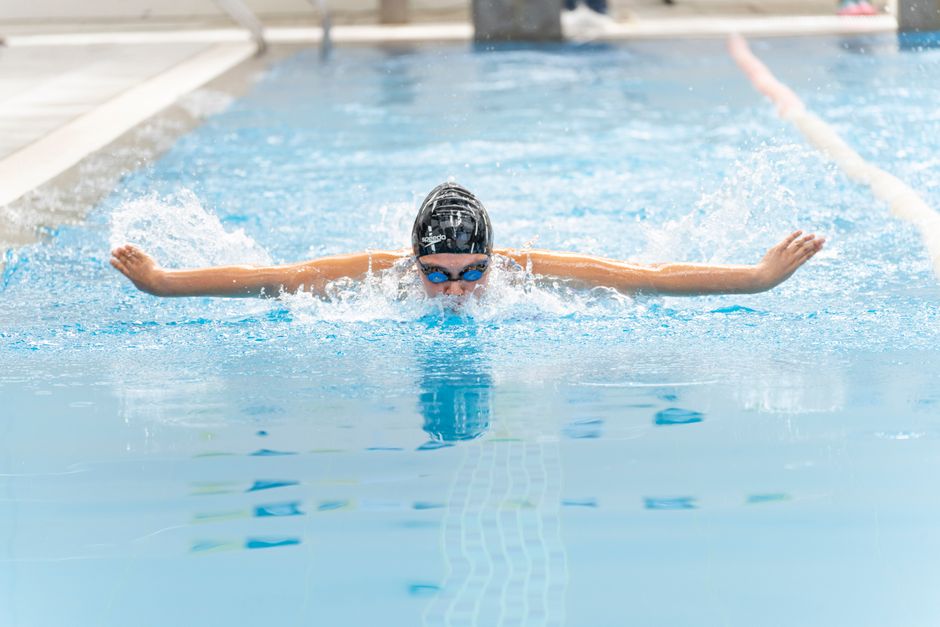
A 13-year-old Chinese swimmer has announced herself on the continental stage in spectacular fashion, with Yu Zidi clocking the fastest time in the women's 200m butterfly heats on the opening day of competition at the 20th Asian Games in Japan. The teenager, who will not turn 14 until next month, finished nearly 2.70 seconds clear of her nearest rival — compatriot Chang Mohan — and enters Sunday evening's final as the heavy favourite for gold.
Yu Zidi sets the pool alight
Yu's dominant performance in the heats was one of the standout moments of the Games' opening day of competition, drawing immediate attention to the young prodigy's potential on the major international stage. Her commanding margin over the rest of the field, including her fellow Chinese swimmer Chang Mohan, underlined just how far ahead she is of her peers in the event at this level.
She was not the only Chinese swimmer to impress. Pan Zhanle, the men's 100m freestyle world record holder and reigning Olympic champion, also advanced to his final in the fastest time, clocking 48.07 seconds — though he had only 0.06 seconds to spare over South Korea's Hwang Sun-woo in a closely contested heat.
Japan's Hojo wins the Games' first gold, China bounces back
The honour of winning the first gold medal of the 20th Asian Games went to the host nation, with Japanese triathlete Takumi Hojo crossing the finish line first in the men's individual event held in Gamagori city, near Nagoya. Hojo completed the 750-metre swim, 20-kilometre bike ride and 5,000-metre run in a time of 52 minutes and 56 seconds, finishing nine seconds ahead of China's Zhang Xirui, who claimed silver. Kazakhstan's Arlan Zhanabay rounded out the podium in third, a further six seconds back.
The 30-year-old Hojo described the win as a significant moment for the Japanese team. "As it's our first gold medal, it's given the Japanese team a real boost," he said. "I was really fired-up. Even the rain held off, and I was in top form right up until I stood on the starting line." The victory also serves a practical purpose for Hojo — it qualifies him for the 2028 Olympics in Los Angeles.
China responded strongly in the women's individual triathlon, with Lin Xinyu going one better than her silver medal performance at the previous Asian Games in Hangzhou, winning in a time of 57 minutes and 37 seconds. Compatriot Huang Anqi finished 21 seconds behind to complete a Chinese one-two, with Japan's Manami Hayashi claiming bronze in 58:36.
Games dogged by logistical headaches
The event, held in Nagoya and across Aichi prefecture, was officially opened on Saturday by Japan's Emperor Naruhito, though the ceremony took place in front of a noticeably sparse crowd at the 30,000-capacity stadium. The Games run for two weeks, with the closing ceremony scheduled for October 4, and feature more than 40 sports and 469 gold medals — a scale that exceeds even the Olympic Games in terms of athlete numbers, with more than 11,000 competitors taking part alongside some 6,000 officials.
Organisers have faced considerable criticism in the lead-up to competition. In a cost-cutting move, a traditional athletes' village was scrapped in favour of a combination of temporary container-style accommodation, hotels and the cruise ship Costa Serena. Several teams have complained about the quality of the huts, including beds being too short for taller athletes, and some competitors were left stranded at the airport after transport failed to materialise.
A diplomatic incident also cast a shadow over proceedings when North Korea's national anthem was mistakenly played ahead of a preliminary men's hockey match involving South Korea on Friday. Games organisers issued their "deepest apologies" over the error.
Despite the off-field disruptions, the sporting action itself has opened with significant drama — and few storylines have captured attention quite like that of a 13-year-old from China who looks poised to make history in the pool.


