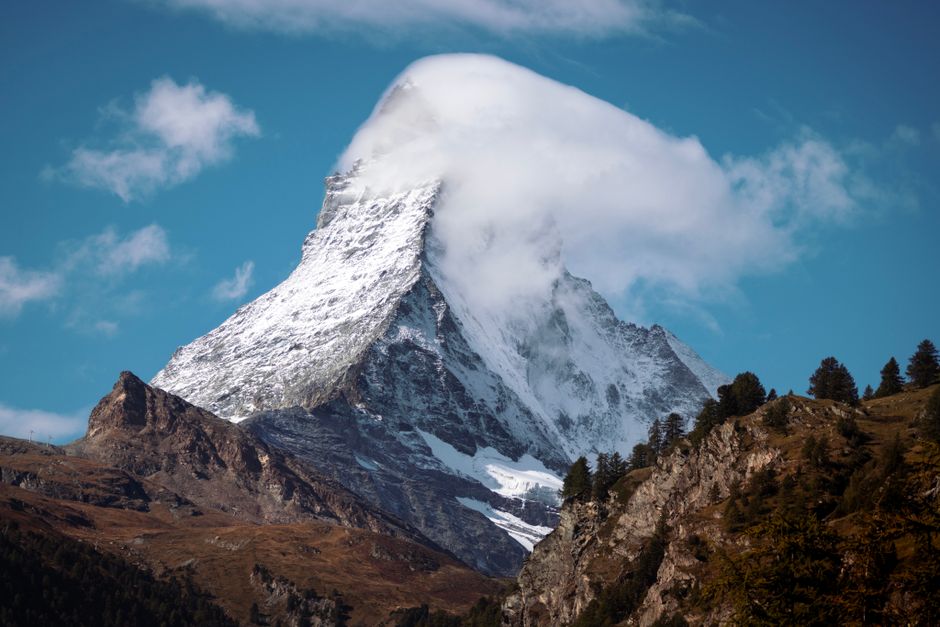
Swiss Alpine glaciers have lost 5.5 per cent of their total ice volume this year — the second-largest percentage decline ever recorded — driven by record-breaking summer heat and dangerously low winter snowfall. The losses have alarmed scientists, with one striking image of the Matterhorn stripped almost entirely of its snow cover in late September drawing widespread attention as a visible emblem of accelerating climate breakdown.
A Matterhorn 'Highly Unusual' to See Bare
The 4,478-metre Matterhorn, straddling the border between Switzerland and Italy, was photographed late in September with virtually no snow remaining above the 4,000-metre mark — a sight that experts say should not occur at that time of year. Geomorphologist Jan Blöthe of the University of Freiburg described the absence of snow at that altitude as "highly unusual", a term that understates just how far conditions have shifted from historical norms.
The dramatic visual came after Switzerland recorded its hottest summer on record in 2026, according to the national meteorology and climatology body MeteoSwiss. That exceptional warmth, compounded by a winter that delivered far less snow than average, created near-perfect conditions for accelerated ice loss across the country's glacier network.
Five Years of Devastating Ice Loss
The scale of the retreat goes well beyond a single bad season. Swiss glacier monitoring service GLAMOS and the Swiss Academy of Sciences report that nearly a fifth of Switzerland's total glacier ice volume has vanished in just five years. The situation has worsened so sharply that the total ice volume today is roughly one-third of what existed 23 years ago — meaning each percentage point of loss today represents far less physical ice than the same figure did in 2003, yet the rate is faster.
The all-time record for glacier retreat remains 2022, when summer heat waves coincided with low snowfall and an unusual deposit of reddish Saharan dust that darkened glacier surfaces and caused them to absorb significantly more solar heat.
Matthias Huss, who heads GLAMOS and holds a glaciology professorship at the Federal Polytechnic Institute ETHZ, was unequivocal about the cause: "The warming that we are experiencing now can be attributed 100 per cent to anthropogenic climate change. It's as simple as that." He added that without human emissions from fossil fuels, there would be no warming of this kind.
Huss also explained why winter snow matters so critically: it protects bare ice from melting during warmer months and, at high elevation, can compact over time to form new glacier ice. Without adequate snowfall, glaciers lose both their shield and their source of renewal. "Alpine glaciers have no chance of surviving in the long term under such conditions," the GLAMOS statement warned.
The Implications Reach Far Beyond Switzerland
The consequences of Switzerland's glacier crisis extend across an entire continent. Known as the water tower of Europe, Switzerland feeds some of the region's most vital river systems — the Danube, Po, Rhine and Rhone — all of which depend partly on glacial meltwater to maintain flow, particularly during dry seasons.
This year's extreme melt season saw 2.2 trillion litres of water lost between July and September alone — equivalent to four times Switzerland's annual national water consumption. Individual glaciers shrank in average thickness by between 2.5 and 4 metres, with the tongues of some glaciers retreating by as much as 10 metres.
Switzerland also generates more than half of its electricity through hydropower, meaning glacier loss has direct consequences for domestic energy supply.
The crisis is not confined to Europe. Experts have linked global warming to the destabilisation of a Himalayan slope that collapsed in August, triggering catastrophic flooding across Nepal. Satellite data has documented dramatic glacier retreat across Greenland and Antarctica over the past half-century. Europe, however, is currently warming faster than any other continent on Earth — making the Alps a particularly acute frontline of a global emergency.


